Finding players near you: LANs, meet-ups and apps
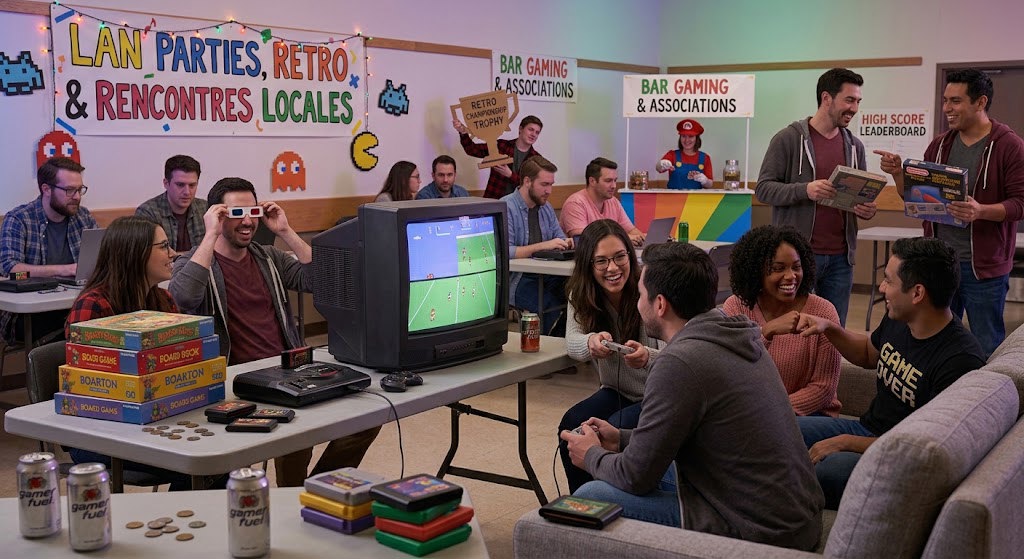
Statistically, there are hundreds of players within ten kilometres of you. Their number was never the problem: it's that none of them wear a sign, and gaming is one of the few mass hobbies practised almost entirely behind closed doors.
This article lists the places those people actually go, online and off, and how to find them from where you are.
Why search locally rather than online
An online relationship hangs on one thing: the connection. It survives as long as you play the same game, and fades when one of you moves on.
Geographic proximity opens something else. It makes possible a games evening on a sofa, a shared drive to a convention, a game traded hand to hand, an outing that has nothing to do with gaming at all. It turns a gaming partner into someone in your life — rarely the stated goal, often the real one.
And for some practices there simply is no remote equivalent: split-screen play, retro on period hardware, arcade cabinets, or just watching someone play over their shoulder.
LAN parties
LAN parties didn't disappear with fast broadband, they changed purpose. People no longer go for the better connection, they go for the atmosphere: one room, dozens of people, two days straight.
Three formats exist. Large national LANs gather several hundred to several thousand players over a weekend, with structured tournaments. Local club LANs bring twenty to a hundred people into a community hall, often for a modest fee — the most welcoming format when you turn up alone. Private LANs are arranged between acquaintances, at someone's place, six or eight strong.
To find them: search "LAN" plus your county or region on Facebook Events, still the main channel for this scene. Regional gaming associations and computer-science student societies run them regularly.
If you're going alone for the first time, arrive during setup rather than mid-session: building your station next to someone creates a natural conversation that tournament hours no longer allow.
Gaming bars and cafés
Most mid-sized towns now have at least one: arcade cabinets, consoles freely available, sometimes networked PCs, with themed evenings during the week.
This is probably the easiest entry point, for one specific reason: you can go alone without it being odd, and leave after an hour if it isn't for you. Themed nights — a fighting game tournament, a retro music quiz, a board game evening — work far better than turning up at random, because they gather people who came for the same thing at the same time.
Search "gaming bar", "board game café" or "esports bar" plus your town, and look at their events page rather than just their address.
Conventions and festivals
Big shows are excellent for discovering and mediocre for meeting: you circulate, you queue, you never settle anywhere.
Their real social value is at the edges. Meet-ups organised beforehand by online communities, shared queues, free-play areas where several people sit down together. The useful habit is to announce online that you're going, before you go: that's usually where groups form.
Clubs, shops and specialist venues
This is the most underrated seam, precisely because it's invisible from the internet.
Second-hand and retro game shops almost always have regulars, and the owner knows everyone. A genuine question about a game is often enough to start a conversation.
Gaming clubs and associations run regular sessions, sometimes repair or preservation workshops. Check your local council's website or its register of community organisations: it's tedious, but these groups do no online marketing whatsoever.
Community and youth centres increasingly host gaming sessions, often free, and aren't limited to teenagers despite the assumption.
Libraries have built out gaming spaces substantially in recent years, with tournaments and open evenings. It's free, and the crowd is more varied than elsewhere.
Connection apps
Everything above shares one flaw: it depends on a calendar. One LAN a quarter, one evening a month — in between, nothing happens, and you still don't know who plays what around you.
That's the gap dedicated apps fill. The principle is to make visible what isn't: who plays, what, on which platform, how far away. On PlayShift you filter by games, platforms, age and distance, send an invitation to play, and the conversation starts on what you already have in common. No event to wait for, and it works just as well at 11pm on a Tuesday as on a Saturday.
How to search, concretely
- Facebook Events remains the best tool for local gaming, however dated the platform feels. Filter by town and by leisure category.
- Regional Discord servers — search "Discord" plus your city — often gather several hundred players from the same area.
- Your council's register of community organisations lists groups entirely absent from social media.
- Your local library's events calendar, in print or online, lists gaming sessions.
- Regional subreddits and forums almost always have a recurring thread for finding people to play with.
The first time
Three things make a first outing much easier.
Pick an event with an activity rather than an open venue. A tournament, a workshop, a themed night: there's a running order, so there's never a moment where you don't know what to do.
Arrive early. Walking into a half-empty room is infinitely easier than walking into a full one where the groups have already formed.
Give yourself an exit. Knowing you can leave after forty minutes without it being a problem removes most of the pressure — and generally, you end up staying.
Frequently asked questions
How do I find players near me?
Three complementary channels: local events (club LANs, gaming bars, libraries), permanent venues (clubs, retro shops), and apps that filter by distance and games owned.
Do LAN parties still exist?
Yes, they've only changed purpose: people go for the atmosphere, not the connection. Local club LANs, twenty to a hundred people, are the most approachable when you're coming alone.
Where do I find gaming events in my town?
Facebook Events first, then regional Discord servers, your council's register of community organisations and your library's calendar. The last two list groups that are invisible on social media.
Is it awkward to go to a gaming night alone?
It's the most common case, and organisers know it. Favour a format with a structured activity and arrive at the start: those two things alone remove the difficulty.
What if I live far from everything?
Widen the search to the county, and let day-to-day play happen online with people you can still meet a few times a year. An hour's drive is compatible with a monthly meet-up.
And between events?
PlayShift makes the players around you visible: filter by games, platforms and distance, send an invitation to play, and the conversation starts on what you have in common.
Download on
 Google Play
  App Store